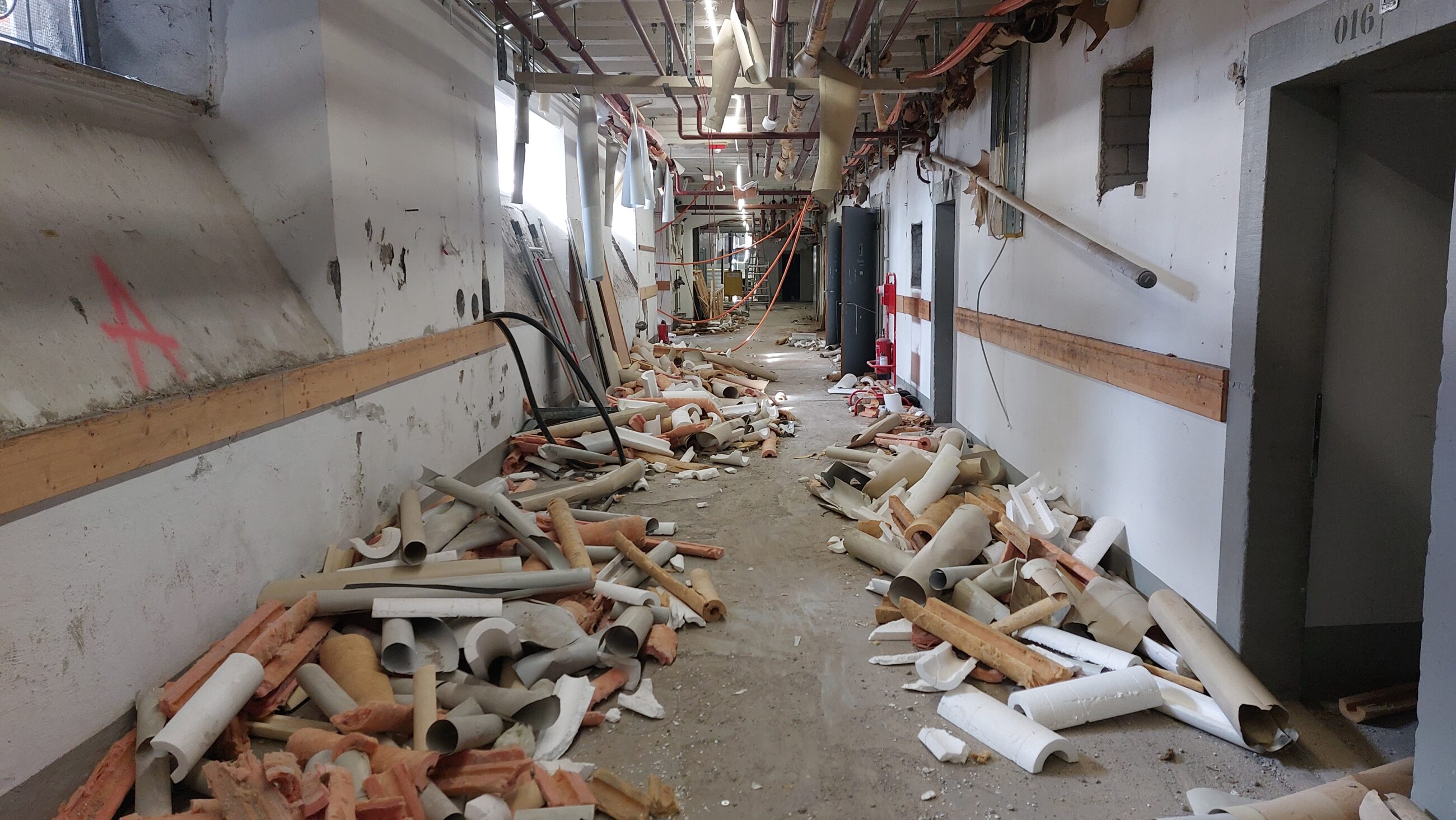
Since 2022, Ecosens AG has been supporting the Canton of Zurich’s «Zurich Military Barracks—Comprehensive Renovation and Conversion» project in the city of Zurich in the area of building contaminants. The project began with existing third-party expert reports, on the basis of which we conducted targeted, detailed investigations and compiled all findings into a comprehensive documentation. The client is the Department of Public Works of the Canton of Zurich.
The building’s occupancy posed a particular challenge: In-depth investigations, particularly test borings, could not be carried out until the occupants had moved out shortly before the start of the renovation. Technical planning and the preparation of the bid documents were therefore completed prior to the execution of the test pits. Consequently, the plans had to be continuously updated to reflect the findings obtained during the course of further investigations.
Historic preservation also posed special challenges. The planned remediation of hazardous substances had to be balanced with the preservation of architectural elements worthy of protection. This included, among other things, paint coatings on historic wooden structures (wainscoting, baseboards, door frames), asbestos-containing fire protection on the furnishings, and asbestos-containing abrasion on protected base plaster.
Ecosens AG provided technical support for the remediation work and ensured that the measures to address hazardous substances were implemented correctly. In addition to typical sources of asbestos, such as tile adhesives, asbestos-containing plaster, flooring, and fire-retardant materials, anti-corrosion coatings containing heavy metals were also remediated.
As part of the phased renovation and gutted-out renovation, previously unknown sources of hazardous substances were also discovered. Particularly challenging were old heating pipes from the 1920s, which had been encased in lightweight, asbestos-containing panels and retrofitted with PU insulation in the 1960s without the old asbestos insulation being completely removed. To determine the actual extent of the problem, all piping in the building had to be stripped and inspected along its entire length.
This project clearly demonstrates how important flexible, technically sound planning for hazardous materials and a strong team are for renovation projects involving historic buildings—especially when new findings come to light only during the course of the work.
Contact: Lukas Uhlmann